Bankruptcy Edmonton
Eliminate overwhelming debt and get a financial fresh start. Our Edmonton Licensed Insolvency Trustees guide you through the bankruptcy process, stop collections and explain which assets you can keep.
- Eliminate most unsecured debt
- Stop collection calls and interest
- Protect some assets
or call 1-587-701-5681


Free and confidential consultation
Regulated by the Office of the Superintendent of Bankruptcy
Updated:
How does bankruptcy work in Edmonton?
Personal bankruptcy is a legal process, filed with a Licensed Insolvency Trustee under Canada’s Bankruptcy and Insolvency Act, that eliminates most unsecured debt and gives you a fresh start.
When you file for bankruptcy in Edmonton, a stay of proceedings takes effect. Collection calls stop, interest is frozen, wage garnishments are lifted, and unsecured creditors must stop legal action against you.
During bankruptcy, you report your household income, make the required payments, attend two credit counselling sessions, and surrender any assets that are not protected by law.
A first-time bankruptcy can be completed in nine months if you have no surplus income, or 21 months if surplus income payments are required. Discharge isn’t automatic in every case. A creditor, the OSB, or the court can oppose it, and that means a hearing before your debts clear.
Only a Licensed Insolvency Trustee can administer a bankruptcy in Edmonton or anywhere in Canada. Moses Advisory Group’s trustees are licensed and regulated by the Office of the Superintendent of Bankruptcy.
Get free, impartial debt advice from a Licensed Insolvency Trustee. We’ll call to explain your options.
1-hour callback (working hours)
No obligation.
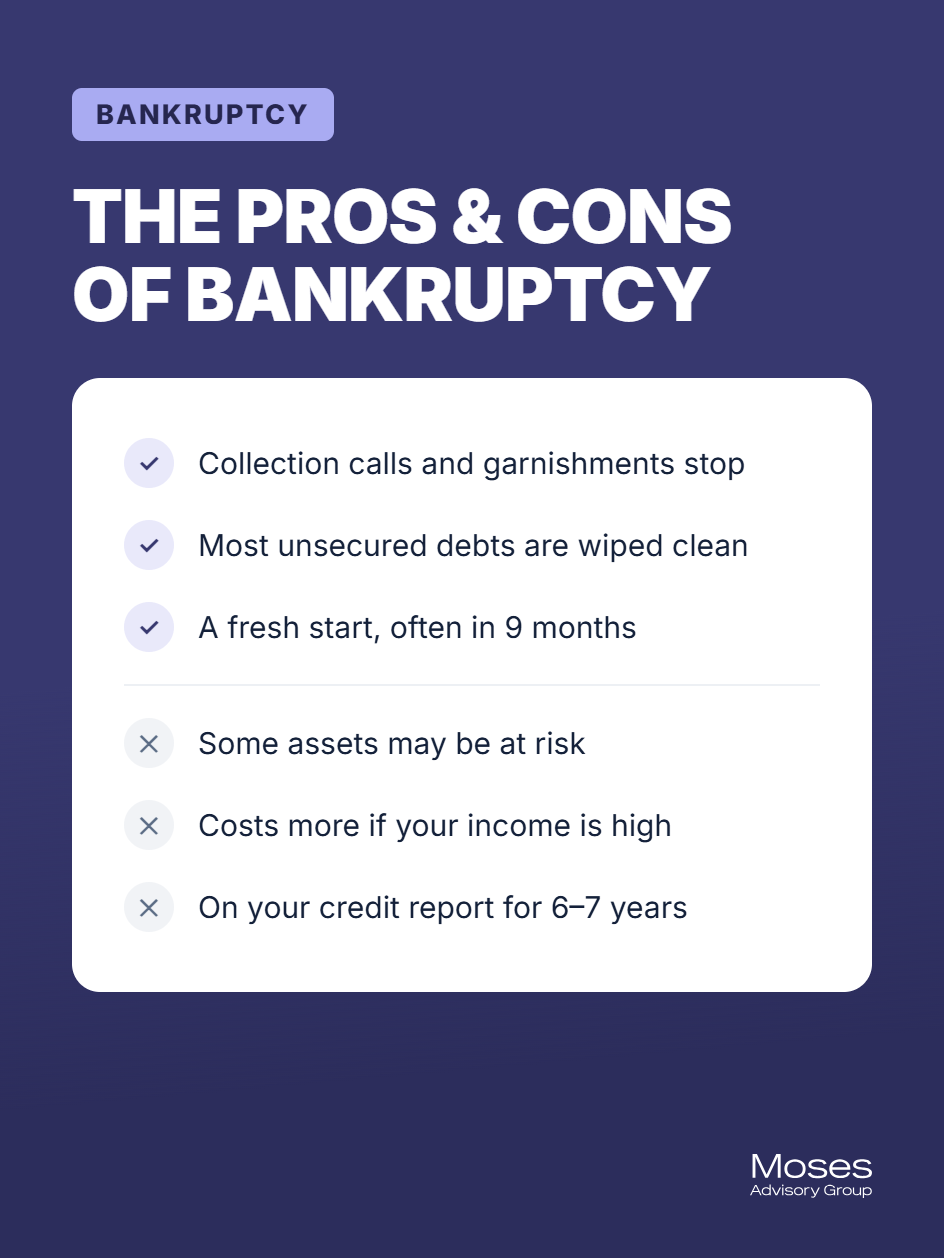
Pros and cons of filing bankruptcy in Edmonton
When you have little hope of resolving your debts, and you’ve exhausted all other options, declaring bankruptcy can sometimes be the best option.
Creditors can no longer legally pursue you for debts, and some of your assets are protected. However, bankruptcy can be expensive and take longer if your income is high. Your assets can also be at risk.
Sometimes, a consumer proposal is a better alternative if you have income and assets to protect.
Assets
Will you lose your house or your assets?
Alberta law protects a certain amount of equity in your home, vehicle, and everyday belongings when you file for bankruptcy. You only lose an asset if its equity exceeds the exemption limit. Even then, you might still be able to keep the asset by paying the difference to the trustee.
Equity is the value of the asset minus the amount you owe on it. For example, if a car is worth $12,000 and you have a $9,000 loan, you have $3,000 in equity. This amount is well under the vehicle limit, so you can keep it.
| What’s protected in a bankruptcy | Amount |
|---|---|
| Equity in your principal residence | Up to $40,000 |
| One motor vehicle | Up to $5,000 |
| Household furnishings and appliances | Up to $4,000 |
| Clothing | Up to $4,000 |
| Tools of your trade | Up to $10,000 |
Source: Government of Alberta – Civil Enforcement Regulation (Alta Reg 276/1995), s. 37
RRSPs and RRIFs are protected under federal law, apart from anything you paid in during the 12 months before you file. In Edmonton, due to rising home prices, many homeowners have equity that exceeds $40,000. As a result, many individuals choose to file a consumer proposal rather than go through bankruptcy, allowing them to keep their homes.
Bankruptcy cost
How much does bankruptcy cost in Edmonton?
There are no upfront fees, and your first meeting with a Licensed Insolvency Trustee is free. A first-time bankruptcy with no surplus income costs about $1,800, paid in nine monthly instalments of roughly $200 each. Trustee’s fees are set by the federal government and deducted from your monthly payment.
Two factors can increase the cost of bankruptcy. If you earn above the government’s income threshold, you pay surplus income. If you own assets with equity above the Alberta limits, you pay to keep them.
As of 2026, the surplus income threshold is $2,716 per month for a single person and $3,381 per month for a household of two. If your monthly earnings exceed the threshold by more than $200, you will be required to pay half of the excess amount into your bankruptcy each month.
Source: Office of the Superintendent of Bankruptcy Canada – Directive No. 11R2-2026, Surplus Income
Surplus income also means your bankruptcy lasts longer. If you don’t have to pay surplus income, a first-time bankruptcy lasts 9 months. If you are required to make surplus income payments, a first-time bankruptcy lasts 21 months.
No in-person visit required.
All types of debt
Bankruptcy can eliminate debt
Credit Cards
Personal Loans
Payday Loans
Overdue Bills
CRA Debts
Student Loans
Overdrafts
Debt collectors
How it works
How to file bankruptcy in Edmonton
Begin with a free consultation. A Licensed Insolvency Trustee will review your income, debts, and assets before advising you on the best debt solution for your situation.
Check if you qualify
Answer a few quick questions
You’ll get a call back
We explain how it works
Discover your options
We’ll create a plan for your debt
Take the first step toward becoming debt free.
No in-person visit needed.
Meet your Edmonton Licensed Insolvency Trustee
Robert Johnson is a Licensed Insolvency Trustee (LIT) with Moses Advisory Group Inc. He has over 20 years of experience and has helped thousands of people in Edmonton and Northern Alberta regain their financial stability through services such as bankruptcy and consumer proposals.
Robert is licensed by the Office of the Superintendent of Bankruptcy and is a member of CAIRP, the Canadian Association of Insolvency and Restructuring Professionals.
“Money worries wear people down. My job is to listen, lay out every option in plain terms, and help you pick the one that protects your home, your income and your peace of mind.”

Robert Johnson, CPA, CA, CIRP, Licensed Insolvency Trustee
Call us on 1-587-701-5681

When does bankruptcy make sense?
Bankruptcy works when you can’t realistically repay what you owe, and you don’t have much in assets or income to protect.
If most of your debt is unsecured, your home equity is low, and your income is at or below the surplus threshold, bankruptcy can clear your debts quickly and cheaply.
Bankruptcy isn’t the right option if you have equity in your home or savings you want to retain, or if your income is above the threshold. In this scenario, a consumer proposal is usually the smarter choice.
Your Licensed Insolvency Trustee (sometimes called a bankruptcy trustee) will help you compare all the available options before you decide.
Reviews
Trusted by Canadians
Real reviews from real clients.
I had a wonderful experience with the Moses Advisory team, especially Janelle. She was kind, supportive, and made the entire process so much easier. I feel at ease and like a huge weight has been lifted off my shoulders.
Soheila Adelian
Nikolas was very kind, helpful and respectful. He explained very clearly and answers all the question politely. He is very professional and you can feel his empathy, sincerity and willing to help. Highly recommended.
Jaime Torres
The Moses Advisory Group team has been excellent. Professional and knowledgeable guidance. Great help in explaining the process and providing the necessary support. Recommend to anyone having financial issues to take advantage of their expertise.
Oluwaseun Fanawopo
Excellent! I was heavily in debt and extremely stressed out, but after the first consultation, they made a very affordable proposal for me. Since that day, my financial situation has improved tremendously! I would highly recommend them to anyone who is suffering from heavy financial difficulties.
Kashaija Stephen
Thanks to Neil from Moses Advisory Group for all your help. I appreciate all your help and understanding through what has been a difficult time. I would highly recommend them.
Candice Knight
Working with this group is great and they helped me greatly. Highly recommend for those with financial problems. Great job guys and thank you so much for all your help.
May Niegos
I’m very glad that this company was able to give us a lifeline during our financial problems. I’m very grateful for all the support especially to Niko who has helped and guided me along the way. I appreciate your support and very kind excellent service. Thank you all and more power to your company!
Jun Abanilla
Excellent service. Professional advice. Anyone who has financial questions and concerns will benefit from visiting their office. What a great experience. Thank you! Thank you!
Isabel Choconta
I’m very happy with Moses. The staff was very helpful, explained things well and are very knowledgable. They always answer the phone when I call or return phone call the same day. I am very thankful for them.
Rory Balchan
More reviews
Location
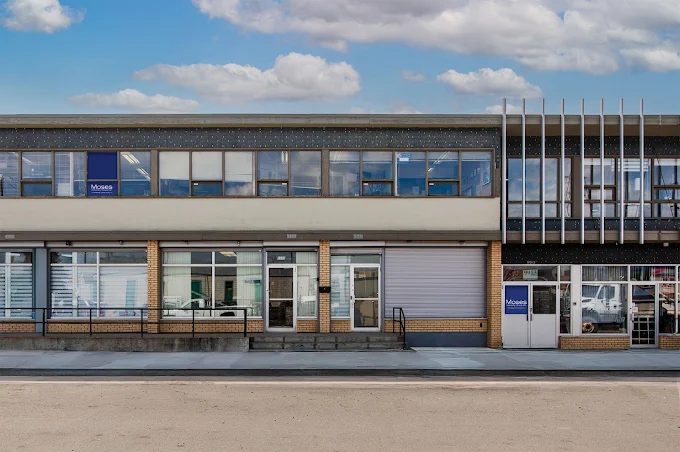
File for bankruptcy at our Edmonton office
Our Licensed Insolvency Trustees serve Edmonton and surrounding communities, including Sherwood Park, St. Albert, Leduc, Fort Saskatchewan, Spruce Grove, and Stony Plain. You can meet with us in person, by phone, or via video. In fact, most clients are able to file their bankruptcy without needing to visit our office.
Inquiries and appointments:
Address:
10408 124 Street NW, Suite 404, Edmonton, AB T5N 1R5
Hours:
Monday – Friday: 8am – 5pm
Saturday: Closed
Sunday: Closed
By appointment only.
Accessibility:
Wheelchair accessible parking.
We respond to inquiries within 24 hours.
Other options
Other debt relief options in Alberta
Bankruptcy and a consumer proposal aren’t the only ways to resolve debt. During your free consultation, your trustee will explain all of your debt relief options.
One alternative is Alberta’s Orderly Payment of Debts program, managed by Money Mentors under the Bankruptcy and Insolvency Act. This program allows you to repay 100% of your debt at a 5% interest rate through a court order.
Credit counselling consolidates unsecured debts into one monthly payment, often with reduced interest, but it isn’t binding on creditors and cannot prevent wage garnishments.
Debt consolidation replaces multiple debts with a single loan, simplifying repayment, but it requires a good credit score to get a better loan rate.
A Licensed Insolvency Trustee will explain these options to you and help you file a bankruptcy or a consumer proposal if you decide this is the best way forward.
Locations
Bankruptcies across Edmonton and Northern Alberta
Moses Advisory Group’s Licensed Insolvency Trustees proudly serve Edmonton and surrounding communities. Wherever you live, we’re here to help.
- Central Edmonton
- South Edmonton
- North Edmonton
- West Edmonton
- Mill Woods
- Windermere
- Riverbend
- Castle Downs
- Sherwood Park
- St. Albert
- Leduc
- Fort Saskatchewan
- Spruce Grove
- Stony Plain
- Beaumont
- Devon
How common is bankruptcy in Alberta?
Most people who file for insolvency in Canada don’t go bankrupt. Instead, they file a consumer proposal and keep their assets.
For the 12 months ending March 2026, 78.5% of consumer insolvencies were proposals rather than bankruptcies. Bankruptcies are on the rise too. They increased 5.8%, faster than the 3.7% rise in consumer proposals.
Source: Office of the Superintendent of Bankruptcy Canada – Insolvency Statistics, March 2026
In early 2026, consumer insolvency filings in Canada reached their highest quarterly level since 2009. In both Alberta and Ontario, bankruptcies increased at a faster rate than consumer proposals, which experts read as a sign of deeper financial strain.
Source: CBC News – More Canadians filing for insolvency as cost of living pressures increase
No in-person visit required.
FAQs
Bankruptcy FAQs for Edmonton
About $1,800 for a first-time bankruptcy with no surplus income, paid over nine months. There are no upfront fees. If you earn above the income threshold or have assets above the Alberta bankruptcy exemption limits, you pay more.
Nine months for a first-time bankruptcy with no surplus income. If you earn more than the government threshold, it lasts 21 months. A second bankruptcy takes longer.
Yes, filing for bankruptcy stops wage garnishments immediately. The moment you file, a stay of proceedings stops wage garnishments, collection calls, and most creditor actions, including most CRA garnishments.
Most unsecured debts are eliminated in bankruptcy, including credit cards, lines of credit, payday loans, overdrafts and CRA tax debt. Secured debts, support payments, court fines, and recent student loans are the main exceptions.
Bankruptcy shows as an R9, the lowest rating there is. It drops off your Equifax report six years after discharge. This takes seven years on a TransUnion credit report. A second bankruptcy stays on your credit report for 14 years.
Most people already have missed payments and collections on their credit file by this point, so you’re rarely giving up a clean record, and you can start rebuilding your credit straight after discharge.
It depends on whether you have assets to protect. A consumer proposal lets you keep all of your assets, but it usually lasts for up to five years and you repay more than you would in bankruptcy. Bankruptcy is faster to complete and cheaper if you have little equity and a modest income. A Licensed Insolvency Trustee will show you them side by side so you can decide on the best way forward. See our guide on a consumer proposal vs bankruptcy.
Usually you can keep your car in bankruptcy, but it depends on the value of the vehicle. Alberta protects up to $5,000 of equity in one vehicle.
RRSPs and RRIFs are protected in bankruptcy apart from contributions made in the 12 months before you file.
Bankruptcy only clears your own debts. On a joint loan or a co-signed debt, the other person still owes the full amount, and the creditor can go after them for it. Debts in your name alone don’t affect your spouse’s credit.
Yes. ALicensed Insolvency Trustee (LIT) was formerly called a “Bankruptcy Trustee,” “Trustee in Bankruptcy,” or “Licensed Bankruptcy Trustee.”
The Office of the Superintendent of Bankruptcy changed the title to Licensed Insolvency Trustee in 2016 to reflect their broader role beyond bankruptcy, such as consumer proposals.
In Edmonton, a Licensed Insolvency Trustee is the only professional who can legally file your bankruptcy.
This rarely happens. Your Licensed Insolvency Trustee (sometimes referred to as bankruptcy trustee) files everything with the Office of the Superintendent of Bankruptcy and deals with your creditors on your behalf. Most bankruptcies never involve a court appearance.
Get debt help
Get free advice about bankruptcy in Edmonton
Speak to a Licensed Insolvency Trustee by video, phone, or in person to compare bankruptcy against your other debt relief options.
- In-person, phone or video
- Free with no obligation
- Federally regulated
Free no-obligation consultation.