

In this guide
How much debt are Canadians carrying?
For every dollar of disposable income, Canadian households owed roughly $1.80 in credit market debt in Q1 2026. The debt-to-income ratio rose to 179.6%, marking its sixth straight quarterly increase.
Source: Statistics Canada – National balance sheet and financial flow accounts, Q1 2026
Total Canadian consumer debt reached $2.68 trillion in Q2 2026, up 4.18% from a year earlier and 1.3% from the previous quarter.
Source: Equifax Canada – Q2 2026 Market Pulse Quarterly Consumer Credit Trends and Insights
Debt relief options in Canada
Consumer proposal
A consumer proposal is a legally binding agreement filed under the Bankruptcy and Insolvency Act. You offer your creditors a portion of what you owe, paid in fixed monthly instalments for up to 60 months, with no interest. The remaining balance is forgiven. The moment you file, collection calls, garnishments and lawsuits stop.
A consumer proposal covers credit cards, lines of credit, personal loans, payday loans, tax debt owed to the CRA, and most other unsecured debts. Your home, car, RRSPs, and other assets stay yours. The debt threshold is $1,000 to $250,000 in unsecured debt, not including your mortgage.
Source: Bankruptcy and Insolvency Act
How consumer proposal payments work
The federal government regulates trustee fees, and they’re built into your monthly payment. The total cost is locked in before you sign, so nothing changes later. If you come into extra money, you can pay it off early with a lump sum. Only a Licensed Insolvency Trustee can file a consumer proposal.
A consumer proposal lets you settle for less than you owe. What you actually pay depends on your income, your assets, and what your creditors would get if you went bankrupt instead.
Bankruptcy
Bankruptcy is the last resort. It clears most unsecured debts when there’s no realistic way to repay them. You surrender your non-exempt assets to a Licensed Insolvency Trustee, who sells them and pays the proceeds to your creditors.
For a first-time bankruptcy with no surplus income, it takes nine months. If your income is more than $200 a month above the government threshold, the process takes 21 months. Either way, bankruptcy gives you the same immediate creditor protection as a consumer proposal under the Bankruptcy and Insolvency Act.
Debt consolidation
A debt consolidation loan rolls several debts into one, usually at a lower rate. You go from juggling multiple payments to making a single one each month.
Interest rates at banks and credit unions generally range from 7% to 12% for these loans. Finance companies charge much more, often above 14% on secured products and above 30% on unsecured ones, sometimes with setup fees on top.
Source: Financial Consumer Agency of Canada – Personal Loans
A debt consolidation loan doesn’t reduce your total balance. You still owe the full amount, just on different terms. You’ll need decent credit and a steady income to qualify, and it works best when the debt is still manageable.
Debt management plan
A debt management plan (DMP) is a structured repayment plan set up through a credit counselling agency. The agency negotiates lower or zero interest with your creditors. You then pay one monthly amount to the agency, and it splits the money among your creditors.
Under a DMP, you pay back every dollar of the principal, so no debt is forgiven. Most plans run three to five years.
Both non-profit and for-profit credit counselling agencies offer DMPs, and they typically charge setup and monthly administration fees. Before you sign, add up the total fees and weigh them against the interest you’d save.
If the fees swallow most of your savings, the plan doesn’t make sense. Non-profit agencies tend to cost less, but get the numbers either way.
Debt settlement
Debt settlement means negotiating directly with creditors to accept a lower amount than what you owe. Creditors have no legal obligation to comply. A creditor can say no, and plenty do.
If you want your creditors legally bound to accept reduced payments with full protection from collections, a consumer proposal is the only option that does so. Debt settlement does not offer this security.
Orderly Payment of Debts
The Orderly Payment of Debts (OPD) program is a court-supervised option under Part X of the Bankruptcy and Insolvency Act. It consolidates your unsecured debts into one monthly payment at a fixed 5% annual interest rate. You repay the full amount you owe, with no debt forgiven.
OPD is currently available in Alberta, Saskatchewan, Prince Edward Island and Nova Scotia. Quebec has a similar mechanism called the Voluntary Deposit, or Lacombe Law. Manitoba and British Columbia ran OPD programs but cancelled them.
In Alberta, Money Mentors administers the program for the provincial government. OPD gives you a stay of proceedings that stops collection calls and most legal action, and you keep your assets. But it can’t touch CRA debt, so if you owe income tax or HST, a consumer proposal or bankruptcy is the only way to handle it inside a formal filing.
Source: Justice Laws Website – Bankruptcy and Insolvency Act, Part X
Credit counselling
Credit counselling covers budgeting, money management and debt advice. Non-profit agencies provide free assessments and can steer you toward the right option, whether that’s a debt management plan, a consolidation loan, or a referral to a Licensed Insolvency Trustee.
On its own, credit counselling won’t reduce what you owe. Stick with a non-profit agency. Some for-profit outfits earn commissions when they recommend specific products.
CRA tax debt relief
If you owe money to the Canada Revenue Agency, you have options beyond insolvency.
The CRA can cancel or waive penalties and interest under its Taxpayer Relief Provisions, and you apply with Form RC4288. The tax itself stays, but penalties and interest pile up fast, so the relief can really help.
The CRA grants relief on three main grounds. It considers extraordinary circumstances like serious illness or a natural disaster, its own processing errors or delays, and financial hardship. Requests are limited to the last 10 calendar years.
Source: Canada Revenue Agency – Taxpayer Relief Provisions (Form RC4288)
The Taxpayer Relief Provisions address only penalties and interest. If the underlying tax bill is more than you can pay, a consumer proposal or bankruptcy is usually the better path.
CRA debt, whether income tax, HST, or payroll source deductions, can go into a consumer proposal or be discharged in bankruptcy, where it ranks the same as any other unsecured creditor. For the full picture, read our CRA tax debt relief guide.
Credit card debt relief
Credit cards are the most common debt people bring to a Licensed Insolvency Trustee, and because nothing is secured against them, almost any of the options we discussed above can deal with them. Card issuers also offer hardship programs that pause or reduce interest for a few months, though you have to ask.
Our credit card debt relief guide covers how each option applies specifically to credit card balances, the signs that you need help, and the process of settling with your card issuer.
Compare debt relief options in Canada
| Consumer proposal | Bankruptcy | Debt consolidation | Debt management plan | Orderly Payment of Debts | Debt settlement | |
|---|---|---|---|---|---|---|
| Debt reduction | Partial. You repay some. The rest is forgiven | Most unsecured debt cleared | None. You repay in full | None. You repay in full | None. You repay in full | Varies. Not guaranteed |
| Keep your assets | Yes | Some assets may be surrendered | Yes | Yes | Yes | Yes |
| Interest frozen | Yes, immediately | Yes | No. New rate applies | Usually reduced or eliminated, by agreement | No. Fixed at 5% annually | No |
| Legal protection from creditors | Yes, by law | Yes, by law | No | No | Yes, by court order | No |
| Stops collections and garnishments | Yes, immediately | Yes, immediately | No | No | Yes | No |
| Credit rating impact | R7. Removed 3 years after completion or 6 years from filing, whichever is first | R9. Removed 6 to 7 years after discharge | Depends on payment history | R7. Removed 2 years after completion | R7. Removed 2 years after completion | Varies |
| Typical timeline | Up to 5 years | 9 to 21 months | 2 to 5 years | 3 to 5 years | Up to 5 years | Varies |
| Who administers it | Licensed Insolvency Trustee | Licensed Insolvency Trustee | Bank or credit union | Credit counselling agency (non-profit or for-profit) | Provincial bodies (Alberta, Saskatchewan, PEI, Nova Scotia) | Private company (unregulated) |
| Government regulated | Yes. Bankruptcy and Insolvency Act | Yes. Bankruptcy and Insolvency Act | No | No | Yes. Bankruptcy and Insolvency Act, Part X | No |
Source: Government of Canada – How Long Information Stays on Your Credit Report and Equifax Canada – Consumer Credit Report User Guide
How debt relief affects your credit
A consumer proposal assigns an R7 rating to each account it covers. That stays on your credit report for three years after completion or six years from the filing date, whichever comes first. A first bankruptcy produces an R9 rating and remains for six to seven years after discharge.
Source: Government of Canada – How Long Information Stays on Your Credit Report
A debt management plan and the Orderly Payment of Debts program both carry an R7 rating that drops off two years after completion. Debt settlement has no standard timeline because it’s unregulated and depends on how individual creditors report the outcome.
A debt consolidation loan is just a new loan, so it doesn’t affect your credit the way a consumer proposal or bankruptcy does. Expect a small dip at first, since applying requires a credit check.
Your credit score recovers as you make the payments, because paying off credit cards, loans and other debts reduces how much of your available credit you’re using, and managing one payment is easier than several.
Is there a government debt relief program in Canada?
No. The Canadian government does not run a debt relief program. Consumer proposals and bankruptcy are the only two debt relief options backed by federal law that reduce what you owe. Both operate under the Bankruptcy and Insolvency Act, overseen by the Office of the Superintendent of Bankruptcy, and administered exclusively by Licensed Insolvency Trustees. That’s what makes them “government programs,” but the government has not created a separate debt forgiveness scheme.
Some companies advertise “government debt forgiveness programs.” That phrase is misleading. Here’s what government debt forgiveness actually means in Canada, and which options are regulated.
Debt consolidation loans and credit counselling are private sector products. If someone tells you they’re government programs, that’s a red flag.
Student Loan Repayment Assistance Plan
The federal Repayment Assistance Plan (RAP) is a genuine government program for student loan borrowers. It reduces or suspends your monthly payments based on your income.
Single borrowers earning under $40,000 a year pay nothing. After 15 years in the program, or 10 with a permanent disability, any remaining balance is written off. Learn more about student loan forgiveness programs.
Source: Government of Canada – Repayment Assistance Plan
Licensed Insolvency Trustees vs. debt settlement companies
A Licensed Insolvency Trustee (LIT) is federally regulated by the Office of the Superintendent of Bankruptcy and is the only professional in Canada authorized to file a consumer proposal or bankruptcy. When an LIT files on your behalf, collections stop, wage garnishments stop, and interest freezes. That protection comes from federal law.
A debt settlement company is unregulated and cannot stop collection calls, wage garnishments, or lawsuits. Creditors may refuse to negotiate, and these firms often charge high upfront fees with no guarantee of results.
Some just collect their fee, then refer you to a Licensed Insolvency Trustee anyway. That’s money down the drain.
Signs you need debt relief
Debt doesn’t go from manageable to crisis overnight. But there are clear signals that what you’re doing isn’t working anymore.
If you can’t cover your minimum payments month after month, act quickly. Waiting longer just means more interest and more collection action.
If you are relying on credit for essentials like groceries, gas, or rent, your expenses are exceeding your income. This gap widens each month.
If collection calls are coming in or you’ve received a garnishment notice, informal options like debt consolidation or a DMP won’t fix it. You need the legal protection that only a consumer proposal or bankruptcy can provide.
If you’re borrowing from one source to pay another, whether that’s shifting credit card balances, taking a payday loan to cover a line of credit, or pulling from your overdraft to make a minimum payment, that cycle is hard to get out of and requires change.
If any of these apply to you, talk to a Licensed Insolvency Trustee.
How to choose the best debt relief program
There is no single best debt relief program in Canada. The best option depends on how much you owe, whether your income is enough to cover the payments, and whether you need legal protection from creditors.
Avoid using a private debt settlement company. They charge large upfront fees, creditors don’t have to deal with them, and they can’t stop collection calls or wage garnishments. Go to a Licensed Insolvency Trustee or a non-profit credit counselling agency instead.
If your debt is under $10,000 and you have income to make the payments, a debt consolidation loan or a debt management plan can get things back on track.
If your unsecured debt is between $10,000 and $250,000 and you cannot make ends meet, a consumer proposal is often the right solution. You keep your assets, repay less than you owe, and creditors can’t pursue you while it is in effect. And when there’s no realistic way to repay and few assets to protect, bankruptcy is the process built for exactly that situation. It is not a failure.
Owe the CRA? Its taxpayer relief provisions can cancel penalties and interest, but the CRA won’t settle the tax itself for less than the full amount. A consumer proposal eliminates your tax debt for a portion of what you owe, and bankruptcy discharges it. Our CRA tax debt relief guide covers every option, including payment arrangements.
Still not sure which applies? A Licensed Insolvency Trustee will tell you, for free, with no obligation. Federal rules require them to cover every option available to you, not just a consumer proposal or bankruptcy.
Find the right solution for your debt
Get free, honest debt advice from a Licensed Insolvency Trustee by video, phone or in person.
- Eliminate up to 80% of debt
- One monthly payment
- Stop collection calls
- Stop wage garnishments
- Freeze interest
or call 1-587-701-5681


* Up to 80% reduction depending on your situation.
How to get debt relief
The safest way to get debt relief in Canada is a free consultation with a Licensed Insolvency Trustee or a non-profit credit counsellor.
A Licensed Insolvency Trustee is required by federal directive to assess your full financial situation and explain all debt relief options available to you. This includes formal options such as a consumer proposal or bankruptcy, as well as informal ones like a debt consolidation loan or a debt management plan.
Source: Office of the Superintendent of Bankruptcy – Directive No. 6R6, Assessment of an Individual Debtor
A non-profit credit counsellor is a reasonable first call too, particularly if your debt still feels manageable and what you mostly need is some help with budgeting and a fresh perspective. The assessment is free.
Because they cannot file a bankrupty or consumer proposal, a credit counselling service will likely point you toward a trustee if they cannot help.
Seek debt help as soon as possible. The sooner you act, the more options you’ll have.
The Government of Canada’s Managing Debt page is worth a look too. It clearly explains every available option without selling any of them.
Watch out for debt relief scams
Not every company offering debt help in Canada plays by the rules. Some are predatory. Watch out for anyone promising that your debt will just “disappear” and claims about secret government forgiveness programs that don’t exist.
If a company pushes you to sign on the spot or tells you to stop paying your creditors while it “negotiates,” walk away.
Any company that says it can file a consumer proposal or bankruptcy has to be a Licensed Insolvency Trustee. If they’re not on the OSB registry, they can’t do what they’re promising.
Source: Office of the Superintendent of Bankruptcy – Search for a Licensed Insolvency Trustee
How many Canadians file for debt relief each year?
In 2025, 140,457 Canadians filed for consumer insolvency. That’s the second-highest annual total since tracking began in 1987, and the highest since the 2009 recession.
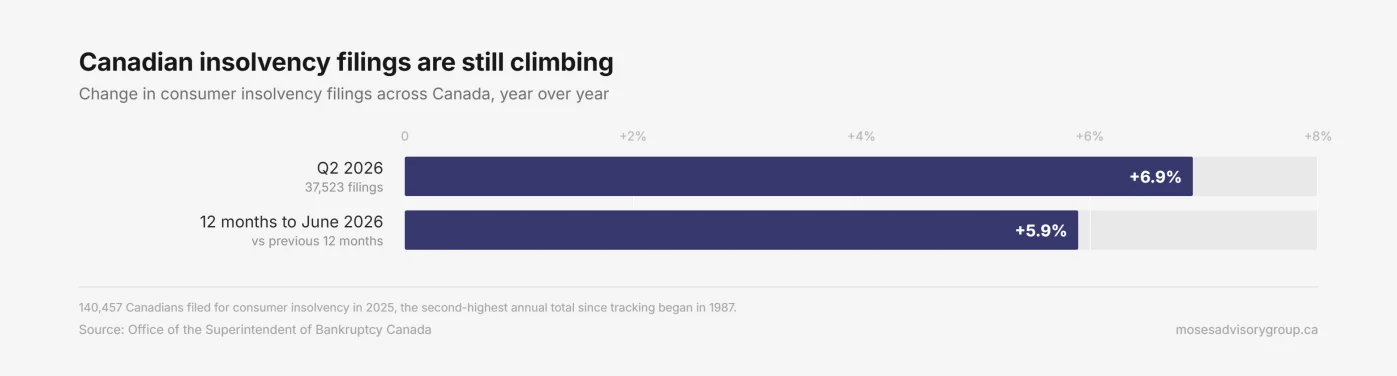
The numbers are still climbing in 2026. In Q2 2026, 37,523 Canadians filed for consumer insolvency, a 6.9% increase from the same quarter last year and the highest since 2009. This averages about 17 filings per hour.
Sources: Office of the Superintendent of Bankruptcy – Insolvency Statistics in Canada, Q2 2026; CAIRP – Q2 2026 Canadian Insolvency Statistics
Alberta is moving more slowly than the national trend. The province recorded 4,932 consumer insolvencies in Q2 2026, up 1.4% year over year, compared with the 6.9% increase across Canada.
Source: Moses Advisory Group – Alberta Insolvency Statistics 2026
For the 12 months ending June 30, 2026, consumer insolvencies were 5.9% higher than during the previous 12-month period. About 78.3% of filings were consumer proposals, rather than bankruptcies.
Source: Office of the Superintendent of Bankruptcy – Insolvency Statistics in Canada, June 2026
Frequently asked questions
What is a Licensed Insolvency Trustee?
A Licensed Insolvency Trustee (LIT) is the only professional authorized by the federal government to administer consumer proposals and bankruptcies in Canada. The Office of the Superintendent of Bankruptcy regulates every LIT, and they act as officers of the court. Before 2016, the title was “bankruptcy trustee.”
Source: Government of Canada – Office of the Superintendent of Bankruptcy
Can I deal with my debt without a consumer proposal or bankruptcy?
That depends on how much you owe. Under $10,000 with stable income? A debt consolidation loan or debt management plan is usually enough. Once the balances climb or your wages are already being garnished, only a consumer proposal or bankruptcy gives you legal protection.
Will debt relief affect my credit score?
Yes. A consumer proposal assigns an R7 rating to each account it covers, indicating to lenders that you’re repaying under a formal arrangement. It stays on your credit report for three years after completion or six years from the filing date, whichever is earlier.
Source: Government of Canada – How Long Information Stays on Your Credit Report
Bankruptcy produces an R9 rating, and a first bankruptcy stays on for six to seven years after discharge.
How do I know if a debt relief company is legitimate?
Look them up on the OSB’s Licensed Insolvency Trustee registry. Any company claiming to file a consumer proposal or bankruptcy that isn’t on that list is lying. Be especially cautious of upfront fees, guaranteed outcomes, and high-pressure sales tactics.
Can I include tax debt in a debt relief program?
Yes. Income tax, HST, and payroll source deductions owed to the CRA can all go into a consumer proposal or be discharged and cleared in bankruptcy, where the CRA is treated like any other unsecured creditor. Separately, you can ask the CRA to cancel penalties and interest through the Taxpayer Relief Provisions.
What you can’t do is roll tax debt straight into a debt consolidation loan. You’d have to borrow the money and pay the CRA yourself.
What about student loans?
Student loans qualify for a consumer proposal or bankruptcy discharge, but only once you’ve been out of school for seven years. Before then, they survive both.
Source: Bankruptcy and Insolvency Act, s. 178(1)(g)
Haven’t hit seven years yet? You can still file a consumer proposal on your other debts, which often frees up enough room to handle student loan payments on their own. The federal Repayment Assistance Plan (RAP) can also lower or pause payments based on your income.
What is the difference between debt consolidation and a consumer proposal?
A debt consolidation loan gives you one new loan to replace several old ones. You still owe every dollar, just at a better rate.
A consumer proposal is a legal agreement where creditors accept a reduced amount and write off the rest. Debt consolidation requires good credit and a lender willing to approve you. A consumer proposal is filed through a Licensed Insolvency Trustee and doesn’t depend on your credit score.
Does bankruptcy eliminate all debt?
Most unsecured debts can be discharged in bankruptcy, but exceptions include child support, spousal support, court fines, fraud-related debts, and certain student loans. Secured debts like mortgages and car loans remain unless you return the asset.
Does Canada have a debt forgiveness program?
No. Consumer proposals and bankruptcy are sometimes called “government programs” because they operate under the Bankruptcy and Insolvency Act and are overseen by the Office of the Superintendent of Bankruptcy, but the government is the regulator, not the provider. We’ve explained what government debt forgiveness actually means in Canada. The one real exception is the Repayment Assistance Plan for student loan borrowers. Anything advertising a new or special government debt relief scheme is misleading.
Get free debt relief advice
Talk to a Licensed Insolvency Trustee about your situation. The first meeting is free, confidential, and without obligation. We help Canadians find debt relief across Alberta, Ontario, British Columbia, Nunavut, and the Northwest Territories.